Mixed-use development
A Full Storefront Starts Before the Lease: Test Demand Before Choosing the Tenant Mix
A practical way for Atlantic City developers and property owners to test commercial uses, compare customer evidence and prepare better tenant conversations.
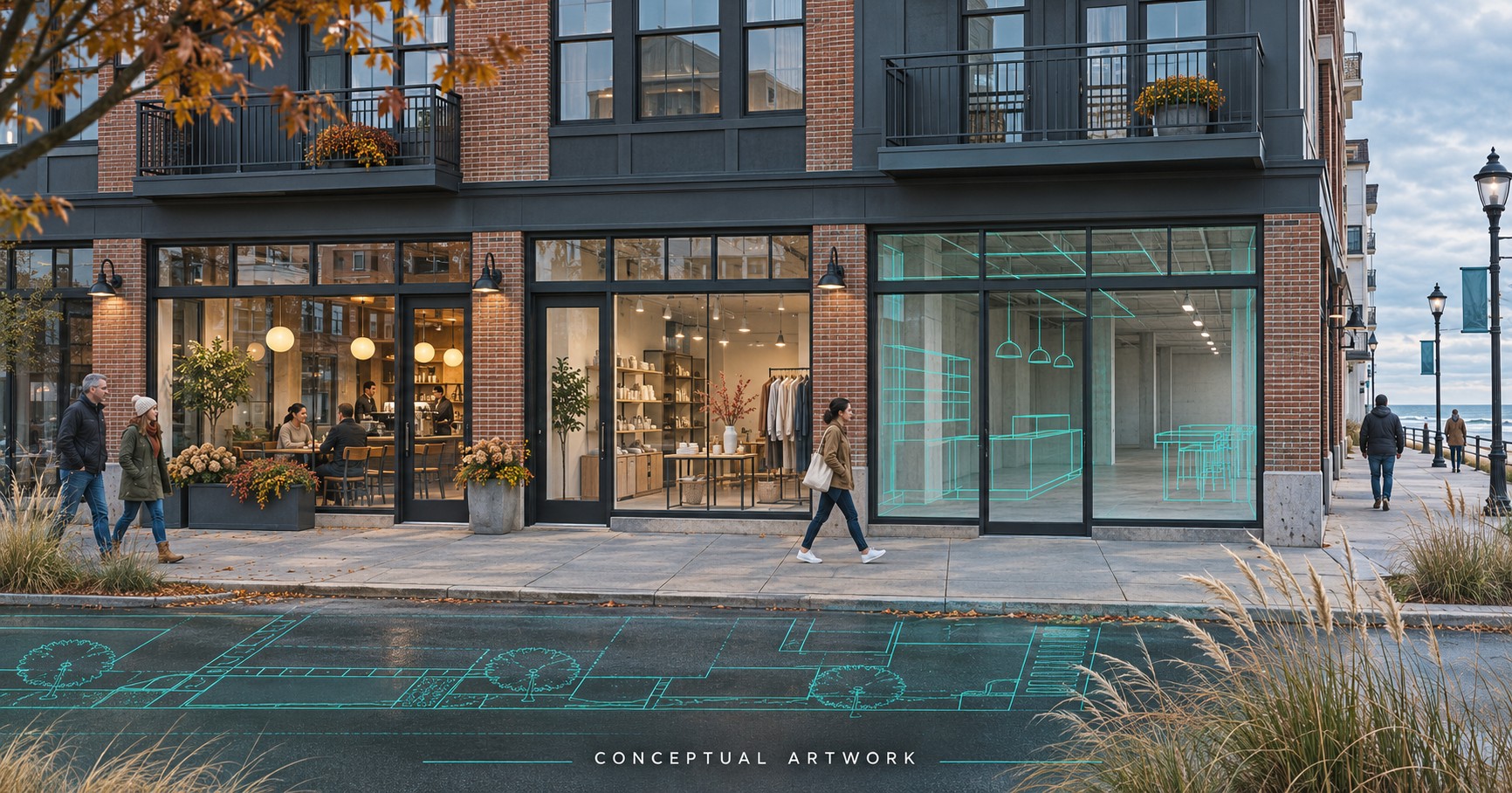
A café in the rendering is a hypothesis.
It may be a good one. But before a development team builds a commercial strategy around it, someone needs to explain who will come, why they will return and what the operator needs to make the space work. For an Atlantic City mixed-use project, “retail below apartments” should lead to a research assignment. The aim is to give the owner and leasing team a clearer basis for choosing which concepts deserve further investigation.
1. Give each concept a customer and a purpose.
Compare a small number of plausible uses, each written as a specific proposition. A breakfast café serving nearby workers is a different proposition from a destination restaurant attracting occasional visitors. Ask what problem each would solve, when customers would use it and what alternatives they have. Keep residents, workers and visitors distinct in the research. Their needs may overlap, but that does not mean they will visit at the same times or support the same offering.
2. Use public data to frame the questions.
The Census Business Builder provides selected demographic and economic information for business research. Use it to explore the relevant area and identify questions about the surrounding customer base and businesses. Record the data period and geographic coverage alongside each finding. A citywide measure is not a storefront sales forecast, and resident data alone does not describe every potential customer. Treat the data as context that needs to be connected to the actual location and concept.
3. Research the alternatives people already use.
The SBA’s market-research guidance recommends examining demand, market size, location, competing options and pricing, using both existing information and direct research. Apply that framework to a shortlist of nearby alternatives. Note what each offers, who appears to use it and what you still need to learn. An empty storefront does not establish an unmet need, just as an existing competitor does not automatically rule out another business. Ask what would make a customer choose this particular offering.
4. Observe consistently, then ask better questions.
Plan observations at comparable times and record the date, weather and any special events that may affect what you see. Look at how people approach the block, where they stop and whether the proposed entrance is easy to find. A few observations cannot establish annual demand. Use them to improve interviews with prospective customers and operators. Ask where people currently go, how often they go and what would make them switch. “Would this be nice to have?” is less useful than understanding an existing habit and the reason behind it.
5. Bring the operator into the physical brief.
Ask prospective operators to describe the space, staffing, equipment, storage, deliveries and operating hours their concept requires. Have the appropriate design professionals test those requirements against the building. Keep commercial interest, technical feasibility and an executed agreement distinct. A promising conversation is valuable evidence about fit, but it does not establish a lease commitment or prove the business will succeed. Give the owner a written list of what has been discussed, what is supported and what remains an assumption.
Compare two concepts on the same evidence.
Imagine an owner considering a café and a neighborhood service business for one vacant bay. For each, summarize the intended customer, reason to return, competing alternatives, operator feedback and likely space requirements. Then identify the weakest assumption. The café might need more evidence about repeat morning demand; the service business might need a different layout. These are hypothetical possibilities, not findings about a specific Atlantic City property. The exercise helps the team choose a useful next investigation instead of selecting a tenant category solely because it looks appealing.
Make the next step smaller than the final commitment.
Before fixing the tenant mix, decide what evidence would justify moving forward, revising the concept or pausing. That could be more structured interviews, a professional layout study or a deeper market assessment. Record who will obtain the information and how it could affect the decision. Iron Tide can help coordinate that work and bring local conversations into the development process. A stronger commercial brief explains the customer, the use and the unresolved questions well enough for the next adviser or prospective operator to contribute.
Practical takeaways
- Define a specific customer and reason to visit for each proposed use.
- Record the geography, time period and limits of the data you use.
- Compare alternatives through consistent observations and customer questions.
- Ask prospective operators what the space and business model must support.
- Choose the next investigation based on the assumption most likely to change the decision.
Working through the commercial mix for an Atlantic City property?
Iron Tide helps developers and property owners organize early research, coordinate local conversations and connect operating requirements to development decisions. Tell us about your space and the uses you want to test.
Start a conversation ↗